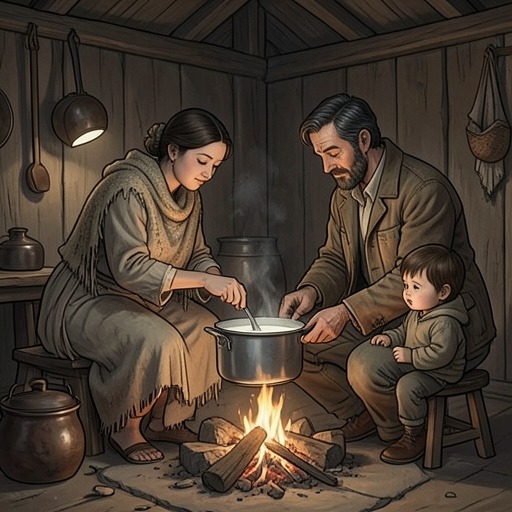
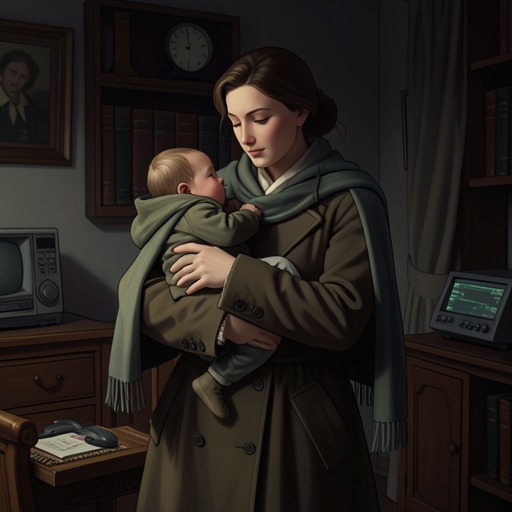
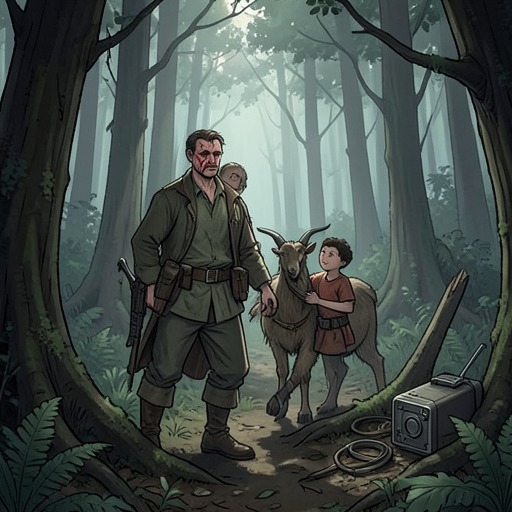
The woodcutter’s wife trades firewood for goat’s milk
The Most Precious of CargoesPoor Woodcutter’s Wife’s exchange of firewood for goat’s milk is the practical bond that allows her adopted daughter to survive. Faced with a child who cannot live on the food she can provide, she enters a feared part of the forest, asks a solitary man for help, and negotiates a daily supply of milk. The bargain does not erase scarcity: it gives care a form that can be repeated, one bundle of wood and one warm cupful at a time.
The child’s need and the journey into the grove
The need is immediate. Poor Woodcutter’s Wife knows that her little cargo cannot survive and thrive without milk. Before leaving, she tries to feed the child kasha porridge, but the baby spits it up; the child’s head nods weakly, and she fears that the gift delivered from Convoy 49 will die in her arms. The mother’s problem is not a lack of devotion but the bodily limit that devotion cannot overcome: she has no milk of her own.
She wraps the child in scarves and in the richly embroidered Prayer shawl, then sets out for a secluded grove where few people venture. The woodcutter’s ax has spared this dense patch of forest; it has no path, and even the parents in the surrounding area fear getting lost there. Poor Woodcutter’s Wife knows it as the Man with the Goat and Shattered Face’s domain. She has seen him at its edge and heard that people fear him, though accounts differ over whether he is hostile to humans or friendly to animals. Now she waits in the darkness, wondering whether he and his nanny goat are there and whether the animal still gives milk.
When the man appears with a rifle, she does not conceal the child’s condition. She explains that without milk that day, her daughter will die. His response is harsh: he asks why she does not give the child her own, and, when she says she has none, he treats the prospect of the girl’s death as replaceable. The exchange begins, then, in a stark conflict between his brusque detachment and her urgent insistence that this particular child must be kept alive.
Negotiating the exchange
Poor Woodcutter’s Wife identifies the source of milk: the man’s nanny goat. She tells him that she heard the animal bleating while she gathered wood along the borders of his territory. He asks what she will give in exchange. She offers everything she has, then admits that she has nothing. Her answer exposes the imbalance between the child’s need and her means; she has no money or valuable possession readily to hand, but she can gather wood.
She proposes bringing a bundle of firewood in return for two mouthfuls of milk. The man objects that she would be paying him with his own wood, and she counters that the wood is not his. When she offers two bundles each day for a small cupful of warm milk, he recognizes her fluency in bargaining. The terms have shifted from a single, urgent request toward a repeated arrangement: more wood for a measurable portion of milk, delivered warm.
The Prayer shawl briefly enters the negotiation as another possible object of value. Asked whether the gods gave her anything precious with the child, Poor Woodcutter’s Wife frees the baby from the shawl and offers it to the man. She points out its fine weaving and gold and silver embroidery. He wraps it around his neck and admires its beauty, but the child’s faint whimper redirects attention from the garment to the need that prompted the meeting. The man examines the baby and recognizes that this supposed divine gift is hungry like any human child. His response turns from mockery to practical care: the shawl may be precious, but what the child requires is nourishment.
A daily supply and the child’s survival
The Man with the Goat and Shattered Face agrees to give milk from his goat, while making clear that it is not the ideal milk for a young child. He says that milk from a jenny would be preferable, but he has none. For the next three months, he instructs Poor Woodcutter’s Wife to dilute the goat’s milk with boiled water, using two measures of water to one measure of milk, and to supplement it with porridge and, when spring comes, fruit and vegetables. His help therefore includes both a supply and specific guidance about how to use it.
Poor Woodcutter’s Wife takes her daughter lovingly and falls to her knees, trying to kiss the man’s hand. He recoils and tells her to get up. He also insists that she never kneel before him or anyone else again, never call him a good man, and never let it be known that he owns a goat and gives away milk. The exchange carries an explicit risk of exposure: his assistance must remain private. She weeps, but the arrangement proceeds, grounded not in public recognition or gratitude but in the practical terms they have established.
Every morning, Poor Woodcutter’s Wife brings a bundle of firewood and receives a warm cupful of milk. The repetition is the point: the child’s need cannot be answered by a single rescue, so the bargain converts help into daily work and provision. The child endures and survives, though she is never fully satisfied. Hunger continues to gnaw at her; once restored enough to make noise, she sucks anything she can put in her mouth and howls without restraint. The milk secures survival without making deprivation disappear.
The exchange’s aftermath
The regular trade belongs to a wider history of care between the woman, the child, the man, and the goat. Later, after Poor Woodcutter’s Wife discovers the Man with the Goat and Shattered Face dead, she covers his body with blossoming branches and prays that he find peace among the gods. She no longer trusts the gods of the train to deserve her gratitude: she understands the child’s survival as the result of the hand that dropped her into the snow and, especially, of the man’s righteousness. Her judgment gives the daily milk exchange its moral weight without turning it into a public display; the man had expressly forbidden praise and disclosure while he lived.
Poor Woodcutter’s Wife leaves with her daughter and the goat, carrying old clothes, tools for making cheese, and freshly made cheese wrapped in the Prayer shawl. Walking east through ruined villages and past tanks and trucks marked with red stars, she eventually settles in a village square, lays out the cheeses, and waits for customers with her daughter on her lap and the goat grazing nearby. The earlier bargain of wood for milk has ended, but its material consequences travel with them: the child has survived, the goat accompanies them, and the tools and cheese offer the basis for a different means of getting by. The episode makes exchange more than a simple payment. Firewood answers the man’s terms; milk answers the baby’s need; and repeated, hidden labor sustains a chosen family through conditions none of them can resolve alone.